Big Fish, Small Pond: Choosing the Language Market for a Faceless Channel
Nobody chooses the pond. They inherit it.
Somebody I coached did everything right except one thing. Sensible niche, clean edits, published on schedule for months without missing a week. The channel never moved. Not slowly – not at all.
When we finally sat down and pulled it apart, the problem was not in a single video. It was a decision made in the first ten minutes of the project, made so quickly it did not feel like a decision at all. He had decided to make a channel in English, aimed at the United States, because that is what “building for an international audience” means. Everybody knows that. So he never questioned it.
He was a small fish, dropped into the most contested stretch of water on the internet, competing with channels that had been swimming there for a decade with budgets he could not match.
He did not lose because he was bad. He lost because he never picked his pond – he inherited it from an assumption.
This article is about picking it on purpose. It is the least glamorous decision in the whole business, it takes an afternoon, and it changes more than another year of practice will.
“International” is a much larger word than “English”
Start by pulling apart the assumption itself. An international faceless channel means an audience outside your own market. That is the whole definition. It does not mean English, and English does not mean the United States.
But those two silent substitutions happen in nearly every beginner’s head, and they walk people directly into the single most crowded market on the platform, which they then blame themselves for failing in.
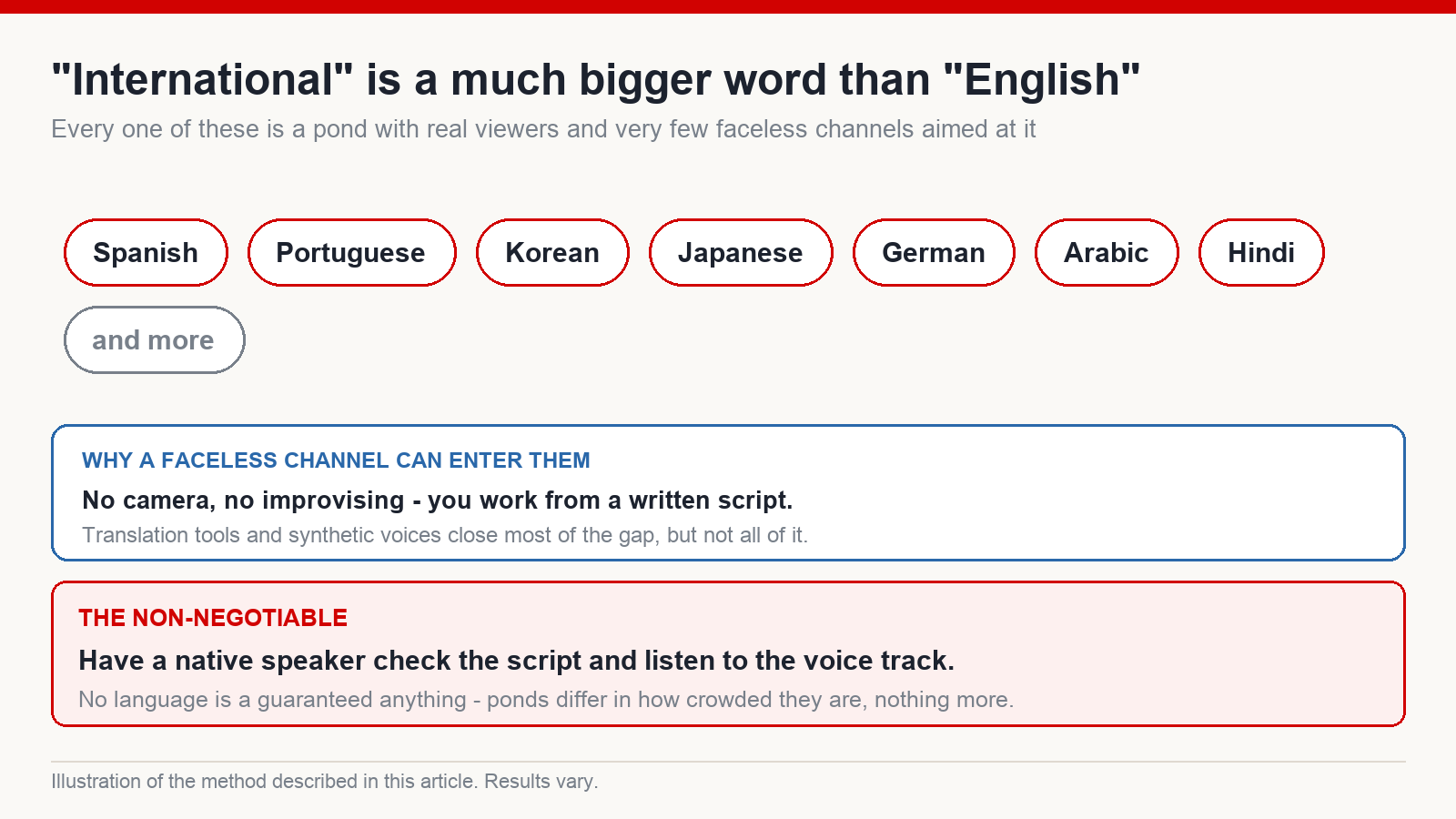
Look at what is sitting there unclaimed. Spanish has one of the largest speaker populations on earth. Portuguese, Korean, Japanese, German, the whole Arabic-speaking world, Hindi and the other major languages of the Indian subcontinent – every one of them is a real audience, watching real hours of video every day, and the number of faceless channels deliberately built for them is a fraction of what points at English-speaking America.
The reasonable objection: I do not speak German. I do not speak Korean.
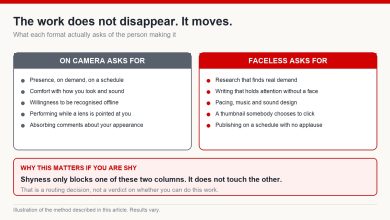
On a faceless channel that matters less than it used to. You are not on camera and you are not improvising – you are working from a written script, and translation tools and synthetic voices have made the gap between “I speak this language” and “I can publish in this language” narrower than it was even two years ago.
Narrower, not closed. I want to be blunt about that, because this is exactly where people get careless. A native speaker hears a bad translation in the first sentence and leaves. A synthetic voice with the stress in the wrong places sounds like a machine reading a phone book. If you go into a language you do not speak, you have to pay someone who does to check the script and listen to the voice track before it goes out. Skip that and you are not entering a market, you are annoying one.
And no language is a guaranteed anything. Ponds differ in how crowded they are. None of them is a gold seam somebody left uncovered for you.
Big fish, small pond
Here is the frame I have kept coming back to for years, and it is the one that stopped me quitting more than once.
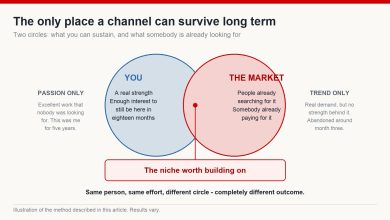
The open ocean is the English-language United States market, and the broad topics everyone aims at inside it. You are a small fish there. Not because you are untalented – because the water already contains channels with a decade of history, teams, and production budgets many times yours. You can swim as hard as you like.
The pond is a market you dig yourself. A less contested language, an audience nobody has bothered to serve properly. In that water, you are the biggest thing swimming.
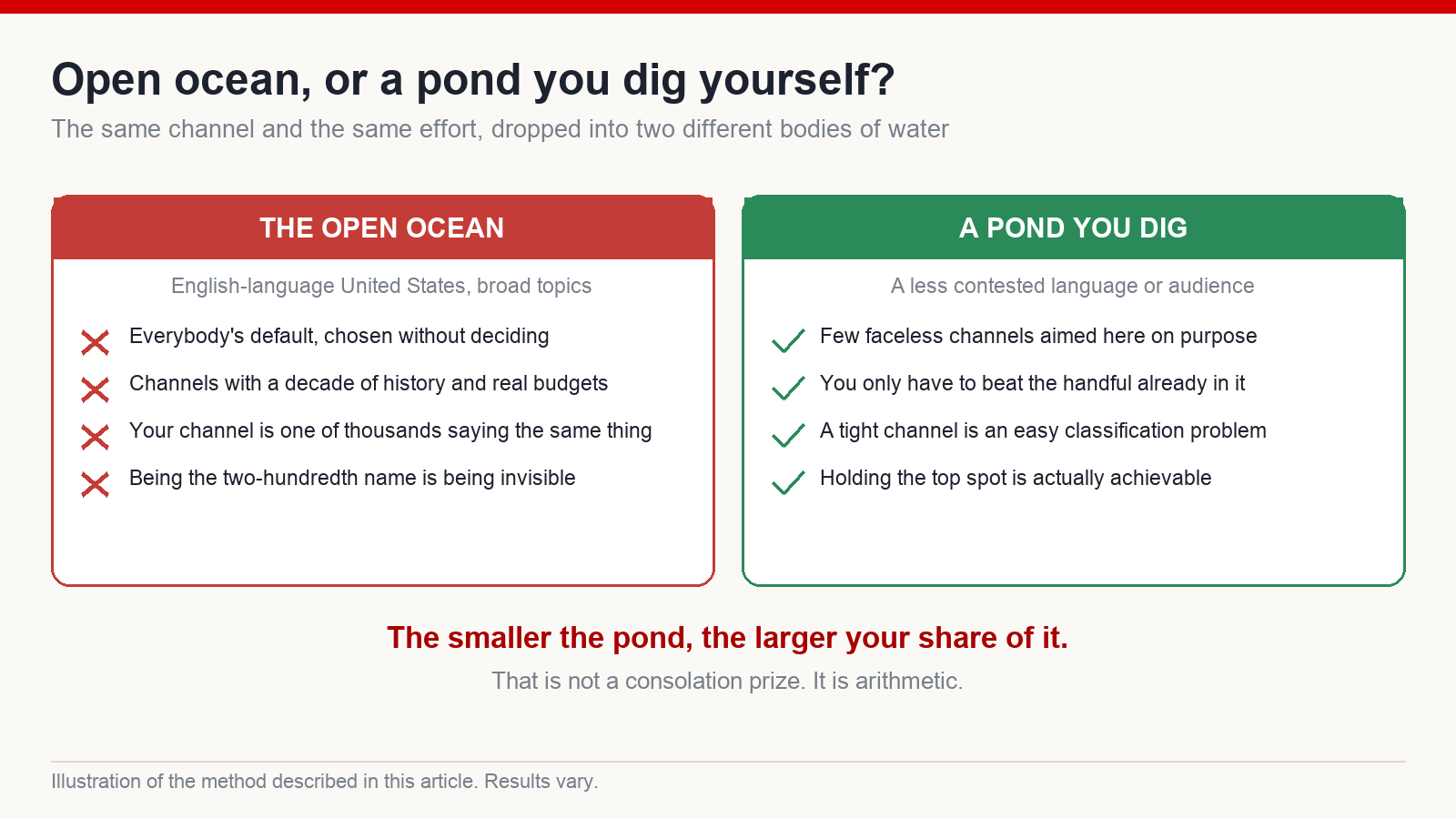
Three reasons the pond wins, and none of them are mystical.
Fewer competitors. You do not have to beat the world. You have to be better than the handful of channels already in that water. For one person working evenings after a day job, that is a target within reach. The other one is not.
The system understands you faster. A tight, consistent channel gives the platform an easy classification problem: this is what it is about, these are the people who stay. A channel that wanders is as confusing to a recommendation system as it is to a human. Clarity is not a virtue here, it is a mechanism.
You can actually hold the top spot. In a small pond, being the first name that comes up for a subject is achievable. In the ocean it is not, and being the two-hundredth name is the same as being invisible.
Which gives the sentence I keep repeating and which people keep hearing as a consolation prize: the smaller the niche, the larger your share of it. It is not consolation. It is arithmetic.
So the honest question is not whether you are good enough. It is whether you are willing to dig a pond, or whether you would rather keep being the smallest fish in a very impressive ocean.
The pond with the views and the pond with the money are rarely the same pond
Now the part almost nobody says out loud to beginners, and the reason so many of them aim at exactly the wrong place first.
Easy views and high advertising rates do not live together. They are pushed apart by the same force: money attracts competition. The more advertisers will pay to reach an audience, the more channels are already fighting for that audience.
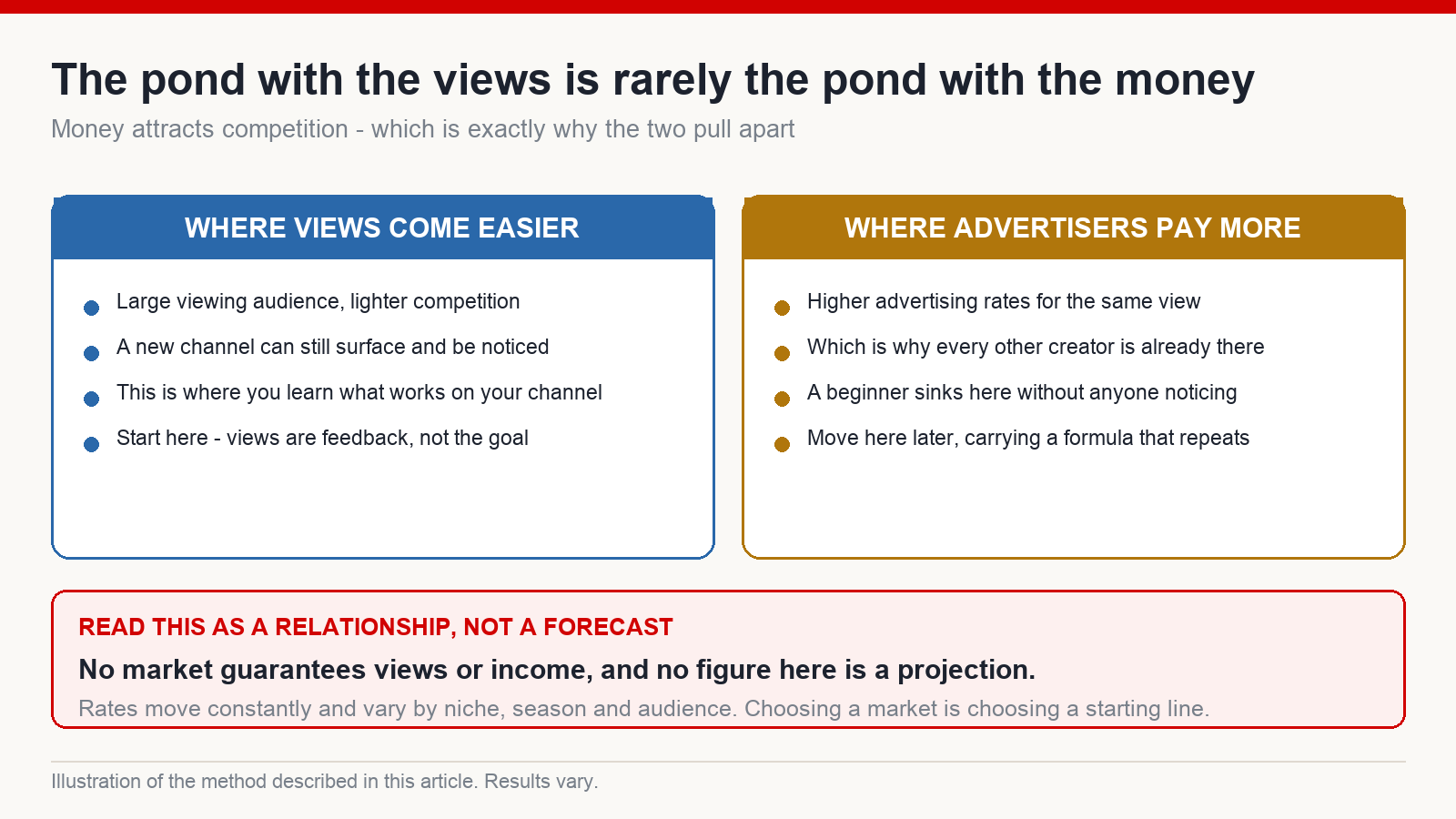
Stay inside English for a second, because even one language splits into two very different ponds. India is an enormous English-speaking viewing audience where a new channel still has room to surface and be noticed. The United States pays some of the highest advertising rates on the platform – and that is precisely why the water is full, and why a beginner dropped into it sinks without anyone noticing they were there.
So where does a beginner go? Toward views first.
Not because views are the goal. Because views are the feedback. Until something of yours gets watched, you have no way of telling a good thumbnail from a bad one, a hook that holds from a hook that leaks. You are guessing in the dark and calling it experience. Get watched, learn what works on your own channel, build a repeatable formula – then move toward the better-paying pond with a formula in hand instead of a hope.
I am not promising either pond produces income, and I am giving you no numbers, because rates move constantly and vary by niche, season and audience. What I am describing is a relationship between two variables, not a forecast. Choosing a market is choosing a starting line that suits your current strength – not sprinting at the finish and collapsing halfway.
If a foreign language still feels impossible: build the formula at home first
There is a group of people for whom everything above is still too big a leap. You want to do this, you understand the argument, and the thought of publishing in a language you cannot read back makes you close the laptop. Or worse – you already tried, ran at a foreign market for months, and got nothing but silence.
Take the long way around. Build a channel in your own language first.
It sounds like the opposite of the plan. It is not. Your native language is where you are fastest and where your judgement is intact. You write scripts quickly. You can hear whether a line lands without running it past anyone. You get watched sooner, which means you get feedback sooner, which is the entire point.
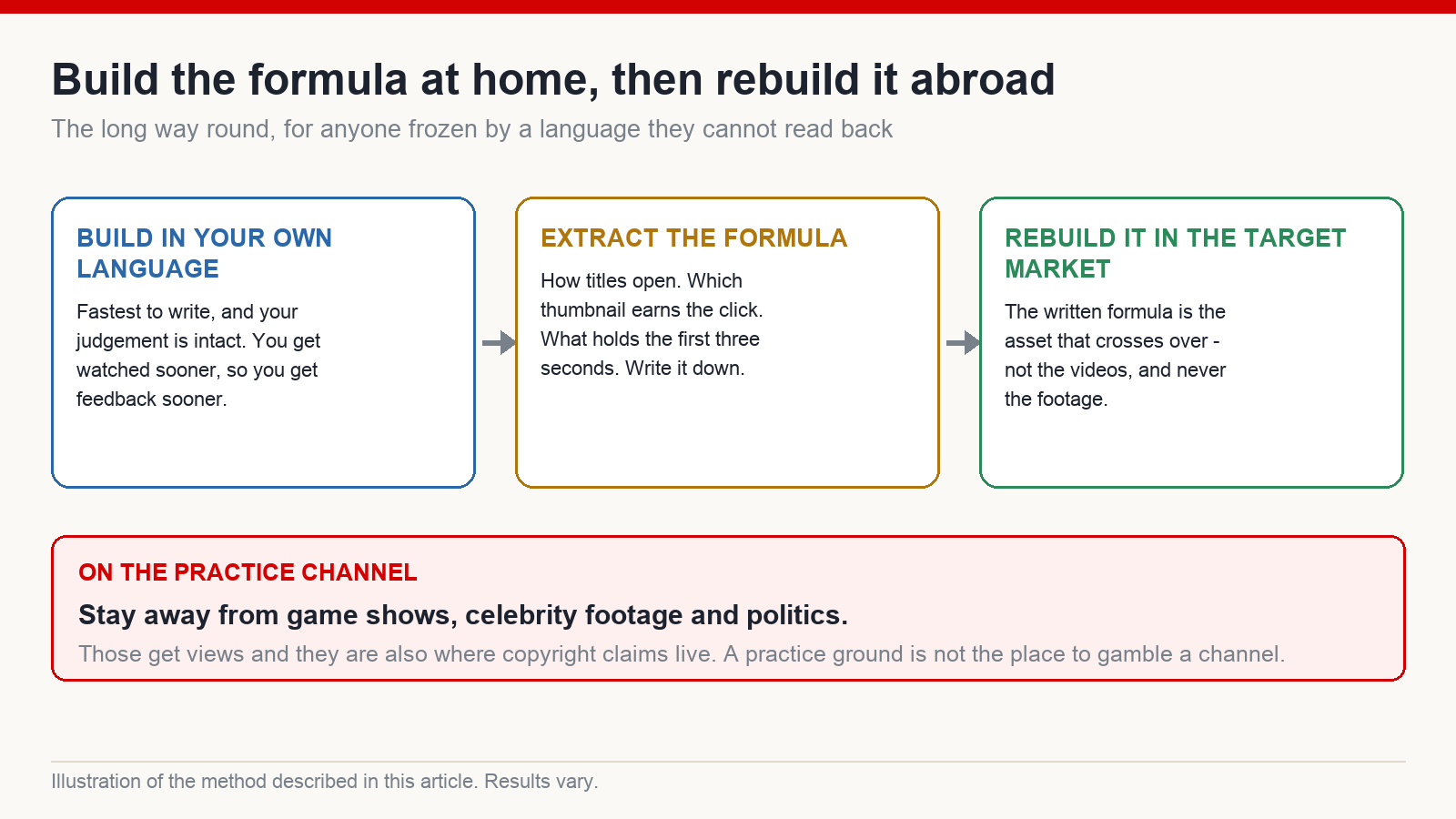
What you are mining for is the formula. How your titles open. Which thumbnail treatment gets the click. What has to happen in the first three seconds so people stay. Write each of these down as you find them – not as a feeling, as a rule you could hand to somebody else. That written formula is the asset. Then you rebuild it in the target language.
One warning, because it goes straight to the fear that keeps people awake: while you are practising, stay away from game shows, celebrity footage and politics. Those subjects get views, and they are also where copyright claims and policy problems live. A practice ground is for learning a formula, not for gambling a channel you will need later. Pick clean subjects and build the habit properly.
Choose one, then stay in it
I have been doing this since 2017 – nine years. What kept me here was not talent. It was refusing to move.
For three or four years I worked one niche around one core subject. Same audience every morning, same kind of video, the way a craftsman sharpens the same blade every day. It was, honestly, boring. And there were stretches where the itch became unbearable: the niche next door was rising, somebody was doing something different and it was working, and I jumped.
I paid for it every time. Every change of direction meant the system had to relearn what my channel was and who to show it to, starting from close to zero. The audience I had built got confused. The new audience had no reason to trust me yet. I dismantled months of foundation with my own hands, more than once, and each time I told myself it was strategy.
So the lesson, and I mean it as the most practical thing in this article: pick the pond that matches what you can actually sustain, then stay long enough for staying to count. Not one style a month. The system needs repetition to understand you, and people need repeated exposure to remember you at all.
Very often you have not chosen the wrong pond. You have simply not been in it long enough. Three months of digging with no water is not proof there is no water.
Four questions, on paper, tonight
You can nod at all of this and change nothing. I did that for years. So here it is as four questions – write the answers by hand, for yourself.
- Which language or subject do I actually fit? Not the most profitable one. The one where you are still not bored in week three, because week three is where most channels quietly stop.
- Is that pond crowded or empty? If it looks empty, resist the voice that says nobody is there because it is worthless. Sometimes that is true. More often nobody has bothered. Check whether there is search demand, then decide.
- Which route am I taking – views first or home market first? Either aim at a market where a new channel can still surface and move toward better-paying audiences later, or build the formula in your own language and rebuild it abroad. Both work. Drifting between them does not.
- How long will I stay before I let myself judge it? Write an actual number. Three months, six months. Then keep your word to yourself, because you will want to break it somewhere around week five.
What I would like you to take away is this: quite often you are not losing because you are bad at this. You are standing in the wrong water. And unlike talent, that is something you can change this evening.
To be clear about the limits: no market guarantees views or income, results depend on your niche, your consistency and a good deal of luck, and none of this is financial advice. If you want a structured English-language programme built around this way of choosing and staying, that is what I run at mmoyoutube.com.
Does a faceless channel for an international audience have to be in English?
No. International simply means an audience outside your own market. Spanish, Portuguese, Korean, Japanese, German, Arabic and the major languages of the Indian subcontinent all have large audiences and comparatively few faceless channels built deliberately for them. English is the default choice, not the correct one.
How do I publish in a language I do not speak?
Carefully, or not at all. A faceless format plus translation tools and synthetic voices gets you most of the way, but you must have a native speaker read the script and listen to the voice track before publishing – native audiences detect a bad translation instantly and leave. If that feels like too much, build in your own language first and clone the format once you have one that works.
Should a beginner aim at an easy market or a well-paying one?
Easy first, in almost every case. You need views before you need revenue, because views are the only feedback that tells you which of your decisions were right. Once you have a formula that repeats, move toward audiences with higher advertising rates. Going straight for the money means competing with everyone else who did the same maths.
How long before I know whether a niche suits me?
Set the number before you start – three months, six months – and hold yourself to it. Constant switching forces the recommendation system to relearn your channel from scratch every time, which is the most expensive thing you can do to yourself. More people fail from leaving early than from choosing wrong.
Is a smaller language market really less risky?
Less crowded is not the same as less risky. You still have to be right about demand, still have to keep publishing, and you carry the extra risk of getting the language wrong. What a smaller pond removes is the specific problem of being invisible next to channels you cannot out-produce. The rest of the work is unchanged.